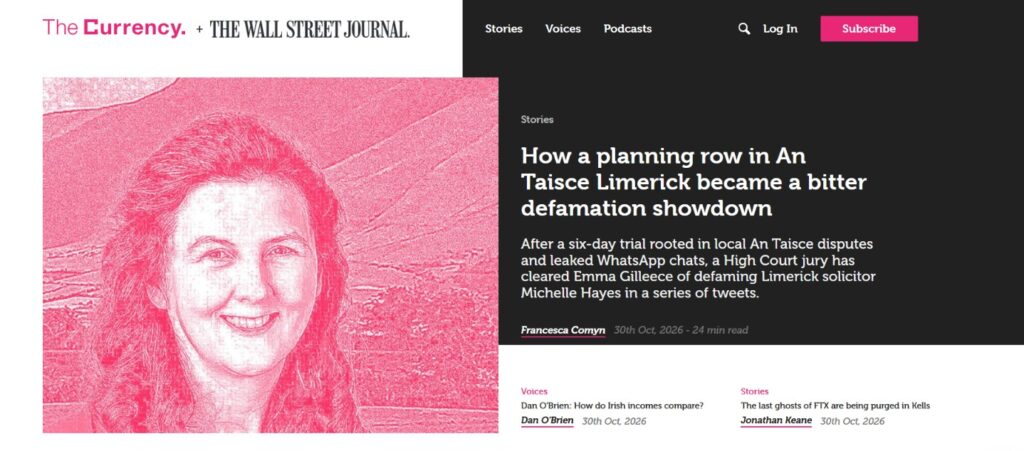
Stephen Kelly Law recently acted for the Defendant in the High Court defamation trial of Hayes v Gilleece1. Mark Harty S.C., and with him Paul O’Shea B.L., were instructed as our Counsel. Ronan Lupton S.C. along with Michael O’Doherty B.L. appeared for the Plaintiff, instructed by Hayes Solicitors of Glentworth Street in Limerick. Each of the five publications put to the jury was successfully defended and no award of damages was made.
Background
The Plaintiff, Solicitor Michelle Hayes, brought defamation proceedings in relation to comments made online by the Defendant, Communications Manager Emma Gilleece, that were critical of Ms Hayes. Ms Hayes contended that they crossed the line from legitimate criticism into defamation. The two had become acquainted in the Limerick branch of An Taisce – the National Trust in 2019.
While they were involved in the branch, Ms Gilleece had disagreed with Ms Hayes’ proposal that An Taisce should object to a student housing complex being built in Punches Cross in Limerick City. This resulted in exchanges of e-mail correspondence, some of which Ms Gilleece viewed as threatening (Ms Hayes disputed this). Ms Gilleece subsequently made comments online that were critical of Ms Hayes.
The Trial
Mr Justice Oisín Quinn presided over the five-and-a-half day trial in the High Court along with a jury. The first day heard evidence from Ms Hayes, whose evidence continued into the second day. The second day also heard evidence from Architect Marcus Mulvihill and the beginning of the evidence of Cllr Elisa O’Donovan, a member of Limerick City & County Council. The third day saw Cllr O’Donovan conclude her evidence, followed by evidence from entrepreneur Diarmaid MacAonghusa and the beginning of Ms Gilleece’s evidence. The fourth day saw the end of Ms Gilleece’s evidence, followed by legal submissions in the absence of the jury.
The fifth day saw further legal submissions on the “issue paper” for the jury, closing speeches by Counsel, and Mr Justice Quinn’s summing up of the case. The jury were asked to consider five different posts and, in each case, whether they bore a particular meaning that was defamatory of Ms Hayes. On the sixth day, the jury returned their verdict. They found that one posting did not identify Ms Hayes (this made it unnecessary to consider meaning) and that the four remaining posts did not have the claimed defamatory meaning.
The Law
Section 2 of the Defamation Act 2009 defines a defamatory statement as a statement that tends to injure a person’s reputation in the eyes of reasonable members of society. Even where a statement is found to be defamatory, there are a variety of defences that are available. These include defences that the statement was privileged or the defence of honest opinion.
An important issue in the trial was how the traditional law of defamation applies to a social media platform such as X (Twitter). Mr Justice Quinn noted that an allegedly defamatory paragraph in a news article should not be considered in isolation from the article itself. By extension, an X post must be seen in the context of any post to which it is replying. Conversely, where X posts were separate and not on the same thread, the reader of one post could not be assumed to have read the other post (applying the Court of Appeal’s reasoning in Gilchrist v Sunday Newspapers Ltd2).
I am pleased we were able to achieve this positive outcome for our client. A defamation trial is fraught with unpredictability and difficulty, and a positive outcome can never be guaranteed, whichever side you are on. The impact the abolition of juries will have remains to be seen, but it does not affect cases that started before the change. Above all, defamation will remain a very high stakes area of litigation, and it is crucial to obtain professional legal advice at the outset.
The above is a general commentary on the law and does not constitute legal advice for your particular circumstances.